
Master Claude Code, Context Engineering, MCP Integrations & Agentic Software Development
John Kim – Build with Claude Code (Cohort 2) is an advanced AI-assisted software engineering program designed to help developers build, test, and improve real-world applications using Claude Code and modern agentic engineering workflows.
Created by John Kim, a Staff Software Engineer at Meta, this cohort-based training explores how artificial intelligence can become an integrated development partner rather than simply a tool for generating individual code snippets. The curriculum combines Claude Code fundamentals, context engineering, custom skills, Model Context Protocol (MCP) integrations, browser automation, multi-agent development, and automated validation.
Rather than relying on one-off prompts, Build with Claude Code (Cohort 2) teaches developers how to create structured systems in which AI agents can understand a codebase, plan implementation steps, execute development tasks, inspect results, and improve their work through repeated testing.
Whether you’re a full-stack developer, AI engineer, technical founder, or experienced software professional looking to improve your development workflow, this program provides practical frameworks for applying Claude Code to increasingly complex engineering projects.
What You’ll Learn
Inside John Kim – Build with Claude Code (Cohort 2), you’ll learn how to:
- Set up and use Claude Code effectively
- Understand the agentic software development process
- Manage large codebases using structured context
- Implement project memory with CLAUDE.md
- Create custom skills and reusable development workflows
- Connect Claude Code to external services through MCP
- Automate browser interactions and UI validation
- Build self-correcting development workflows
- Use Git worktrees for parallel development
- Coordinate multiple AI coding agents
- Automate testing, linting, and quality assurance
- Improve repository documentation
- Reduce repetitive engineering work
- Develop complete AI-assisted applications
What’s Included
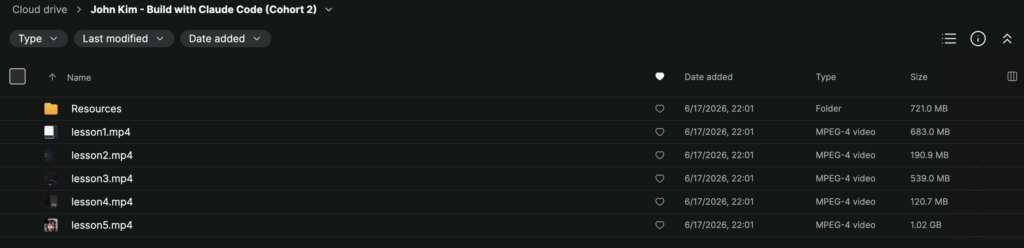
The Build with Claude Code (Cohort 2) program includes:
- Live Interactive Training Sessions
- Lifetime Access to Training Recordings
- Claude Code Fundamentals
- Context Engineering Training
- CLAUDE.md Implementation
- Custom Skills Development
- Model Context Protocol Training
- Browser Automation Workflows
- Multi-Agent Development Systems
- Git Worktree Training
- Automated Testing and Validation
- Practical Engineering Assignments
- Capstone Project
- Peer Learning Community
- Certificate of Completion
Complete Build with Claude Code Curriculum
Session 1 – Claude Code Fundamentals
The first session introduces the tools, workflows, and engineering principles required to use Claude Code effectively.
Instead of approaching AI coding as a series of disconnected prompts, you’ll learn how to structure interactions so the model can understand your project, follow instructions, and complete development tasks within a controlled workflow.
Claude Code CLI Setup
Learn how to configure and navigate Claude Code.
Topics include:
- Claude Code installation and setup
- Command-line interaction
- Project initialization
- Interactive coding sessions
- Permission management
- Development environment configuration
The Agentic Development Loop
Understand how an AI coding agent approaches software development.
You’ll explore the relationship between planning, implementation, verification, and correction.
A typical workflow follows this structure:
Understand the Task → Plan → Implement → Test → Review → Improve
This approach provides a framework for managing AI-assisted development rather than accepting generated code without validation.
Slash Commands & Shortcuts
Learn how to interact with Claude Code more efficiently using commands and shortcuts.
Topics include:
- Command navigation
- Workflow shortcuts
- Development commands
- Session management
- Reusable instructions
Planning Mode Workflows
Discover how to separate planning from execution.
You’ll learn how structured planning can help with:
- Feature development
- Codebase changes
- Architectural decisions
- Complex implementation tasks
- Multi-step engineering projects
Context Management & Memory
Learn how to provide Claude Code with the information it needs to work effectively.
Topics include:
- Context windows
- Project memory
- CLAUDE.md
- Information organization
- Second Brain frameworks
- Lazy loading
- Context efficiency
This section introduces one of the central concepts of the entire program: improving AI coding workflows by improving the information available to the model.
Context Engineering
Context engineering is a major focus of John Kim – Build with Claude Code.
As software projects grow, AI agents need access to relevant instructions, architecture, conventions, and implementation details.
Providing too little information can lead to misunderstandings, while providing excessive or irrelevant information can make development sessions less efficient.
This section explores how to structure context so Claude Code can work with greater clarity.
You’ll learn about:
- Context window management
- Fresh context principles
- Condensed context
- Context compression
- Memory architecture
- Long-term knowledge organization
- Project documentation
- AI-friendly repository design
The goal is to build a context system that supports ongoing development rather than repeatedly explaining the same project details.
Custom Skills & Workflow Automation
Learn how to extend Claude Code using reusable skills and structured instructions.
Rather than manually explaining the same process every time, custom skills allow developers to organize recurring tasks into reusable workflows.
Topics include:
- Custom skill creation
- SKILL.md structure
- Built-in versus custom skills
- Nested skill systems
- Workflow automation
- Reusable development pipelines
- Task-specific instructions
These techniques can be applied to code reviews, documentation, testing, debugging, repository analysis, and other recurring engineering activities.
Practical Engineering Assignments
The program includes practical assignments that help students apply the concepts from the training sessions.
Assignment 1 – Codebase Onboarding
Learn how to use Claude Code to understand an unfamiliar software project.
You’ll explore:
- Repository analysis
- Architecture identification
- Codebase structure
- Documentation review
- Test coverage evaluation
- Engineering audits
- Project summaries
This assignment demonstrates how AI-assisted workflows can help developers orient themselves within existing applications.
Assignment 2 – CLAUDE.md Implementation
Create a structured project memory system for Claude Code.
Topics include:
- Repository conventions
- Development guidelines
- Documentation standards
- Project architecture
- Team knowledge
- Reusable instructions
- AI-ready project organization
A well-maintained CLAUDE.md file can help reduce repetitive prompting and provide consistent guidance across development sessions.
Assignment 3 – Log Triage Automation
Build a custom workflow for handling engineering logs and operational information.
You’ll learn about:
- Log processing
- Automated categorization
- API integration
- Report generation
- Workflow design
- Custom commands
- Engineering automation
This assignment introduces practical applications of Claude Code beyond writing application features.
Session 2 – Scaling With Agentic Engineering
The second session moves into more advanced development workflows.
Once you understand Claude Code fundamentals, context management, and custom skills, the next step is learning how to coordinate tools and agents across larger projects.
This section covers MCP integrations, browser automation, development hooks, parallel workflows, and multi-agent engineering.
Model Context Protocol (MCP)
Learn how to connect Claude Code to external applications and services using the Model Context Protocol.
MCP provides a structured way for AI applications to access external tools and information sources.
Topics include:
- MCP fundamentals
- MCP server setup
- External tool integration
- Connecting development services
- Custom MCP workflows
- Figma integration
- Notion integration
- Slack automation
By understanding MCP, developers can build workflows in which Claude Code interacts with tools beyond the local codebase.
Browser Automation
Discover how Claude Code can be incorporated into workflows that interact with web applications.
Topics include:
- Automated navigation
- Browser interaction
- Screenshot analysis
- Visual verification
- Console monitoring
- UI testing
- Regression testing
- Self-correcting interface workflows
Browser automation can be particularly useful when developing applications that require visual inspection and interactive testing.
Instead of relying exclusively on code-level validation, developers can inspect how an application behaves in the browser.
Agentic Engineering Systems
Learn how to build workflows that combine implementation with automated verification.
Topics include:
- Agent workflows
- Hook lifecycle management
- Development automation
- Self-correcting loops
- Error detection
- Automated testing
- Workflow coordination
One important concept is the Build → Verify → Fix development loop.
Rather than treating generated code as finished, the workflow introduces checks that can identify errors and guide additional improvements.
Parallel Development With Git Worktrees
As projects become more complex, developers may want to work on multiple features or experiments simultaneously.
The course introduces Git worktrees as a way to organize separate development environments.
You’ll explore:
- Git worktree fundamentals
- Parallel development
- Branch isolation
- Multiple working directories
- Safe experimentation
- Feature development
- Managing simultaneous tasks
These workflows can help developers keep separate implementation efforts organized.
Multi-Agent Development Systems
One of the advanced areas of Build with Claude Code (Cohort 2) is coordinating multiple AI coding agents.
Instead of assigning every responsibility to a single agent, developers can divide work into separate tasks with clearly defined roles.
Topics include:
- Agent roles
- Task decomposition
- Workflow delegation
- Agent coordination
- Multi-agent communication
- Parallel task execution
- Development planning
For example, a multi-agent workflow might divide responsibilities among agents focused on implementation, testing, documentation, and code review.
The goal is to understand how multiple development processes can be coordinated while maintaining clear ownership and validation.
Automated Testing & Validation
AI-assisted development still requires reliable quality control.
The program emphasizes validation systems that help developers inspect generated code and identify potential problems.
You’ll learn about:
- Automated testing
- Linting
- Quality assurance
- Regression testing
- Visual validation
- Continuous verification
- Error detection
- Development feedback loops
These practices are particularly important when using AI tools to accelerate software development.
The Five Pillars of Agentic Engineering
The course introduces five interconnected areas that support more advanced AI-assisted development.
1. Context Management
Provide AI agents with the relevant project information, instructions, and technical knowledge required to perform development tasks.
2. Skill Systems
Create reusable instructions and workflows for recurring engineering activities.
3. Agent Coordination
Organize tasks across multiple agents or development sessions.
4. Validation Automation
Use automated checks to identify problems and support iterative improvement.
5. Development Infrastructure
Build the underlying environment that supports repeatable AI-assisted engineering workflows.
Together, these principles provide a framework for moving beyond simple AI code generation toward more integrated development systems.
Capstone Project
The capstone project brings together the concepts covered throughout the program.
Students apply Claude Code and agentic engineering principles to develop a complete software application.
Potential project categories include:
- Full-stack applications
- AI-powered products
- SaaS platforms
- Internal business tools
- Startup applications
- Custom software projects
The implementation framework includes:
- CLAUDE.md systems
- Context engineering
- Custom skills
- MCP integrations
- Agent coordination
- Automated validation
- Testing workflows
The capstone provides an opportunity to demonstrate practical experience with the complete AI-assisted development process.
Why John Kim – Build with Claude Code Stands Out
Many AI coding tutorials focus on generating simple applications or using basic prompts.
Build with Claude Code (Cohort 2) explores the broader engineering practices needed to manage AI-assisted software projects.
The curriculum connects:
Context Engineering → Custom Skills → MCP → Agent Coordination → Implementation → Validation
Key highlights include:
- Advanced Claude Code training
- Practical context engineering
- Reusable development skills
- MCP integration workflows
- Browser automation
- Multi-agent systems
- Git worktree development
- Automated testing
- Real engineering assignments
- Capstone implementation
Key Benefits
By working through the program, developers can strengthen their ability to:
- Use Claude Code more effectively
- Understand unfamiliar codebases
- Build reusable engineering workflows
- Reduce repetitive development tasks
- Organize project context
- Connect AI agents to external services
- Work on multiple development tasks
- Implement automated testing
- Improve code validation
- Build complete AI-assisted applications
Who This Course Is For
John Kim – Build with Claude Code (Cohort 2) is suitable for:
- Software engineers
- Full-stack developers
- Frontend developers
- Backend developers
- AI engineers
- Technical founders
- SaaS builders
- Product engineers
- Engineering managers
- Technical leads
- Developers interested in agentic engineering
The program is particularly relevant for developers who already understand software development fundamentals and want to incorporate AI more deeply into their engineering workflow.
About John Kim
John Kim is a Staff Software Engineer at Meta and an educator focused on practical AI-assisted software development.
His training explores how developers can use Claude Code, context engineering, custom skills, and agentic workflows to improve software development processes while maintaining professional engineering practices.
Through Build with Claude Code, he introduces methods for applying AI across codebase analysis, implementation, testing, automation, and development infrastructure.
Final Thoughts
John Kim – Build with Claude Code (Cohort 2) provides a structured approach to modern AI-assisted software engineering, combining the practical use of Claude Code with more advanced development systems.
From context engineering and custom skills to MCP integrations, browser automation, Git worktrees, multi-agent coordination, and automated testing, the program explores how developers can incorporate AI into increasingly complex engineering workflows.
Rather than relying entirely on AI-generated code, students learn frameworks for planning tasks, organizing project knowledge, managing agents, validating implementation, and improving software through structured feedback.
Whether you’re developing SaaS applications, building AI-powered products, managing existing codebases, or exploring agentic engineering, Build with Claude Code by John Kim provides practical training for developing a more organized and capable AI-assisted software development workflow.