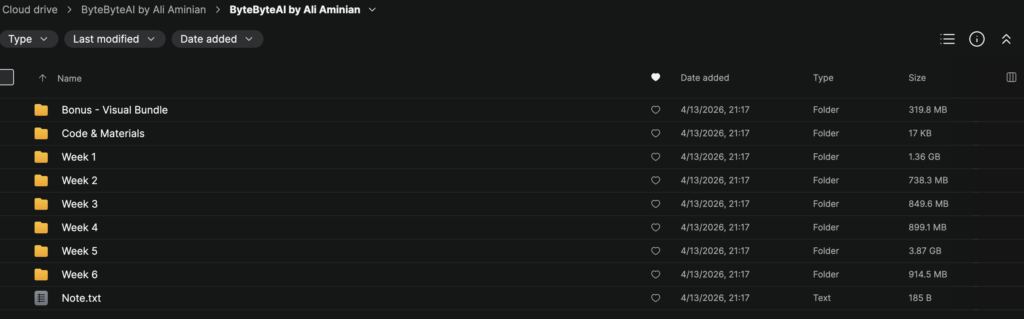
Build Real AI Systems & Become a Job-Ready AI Engineer
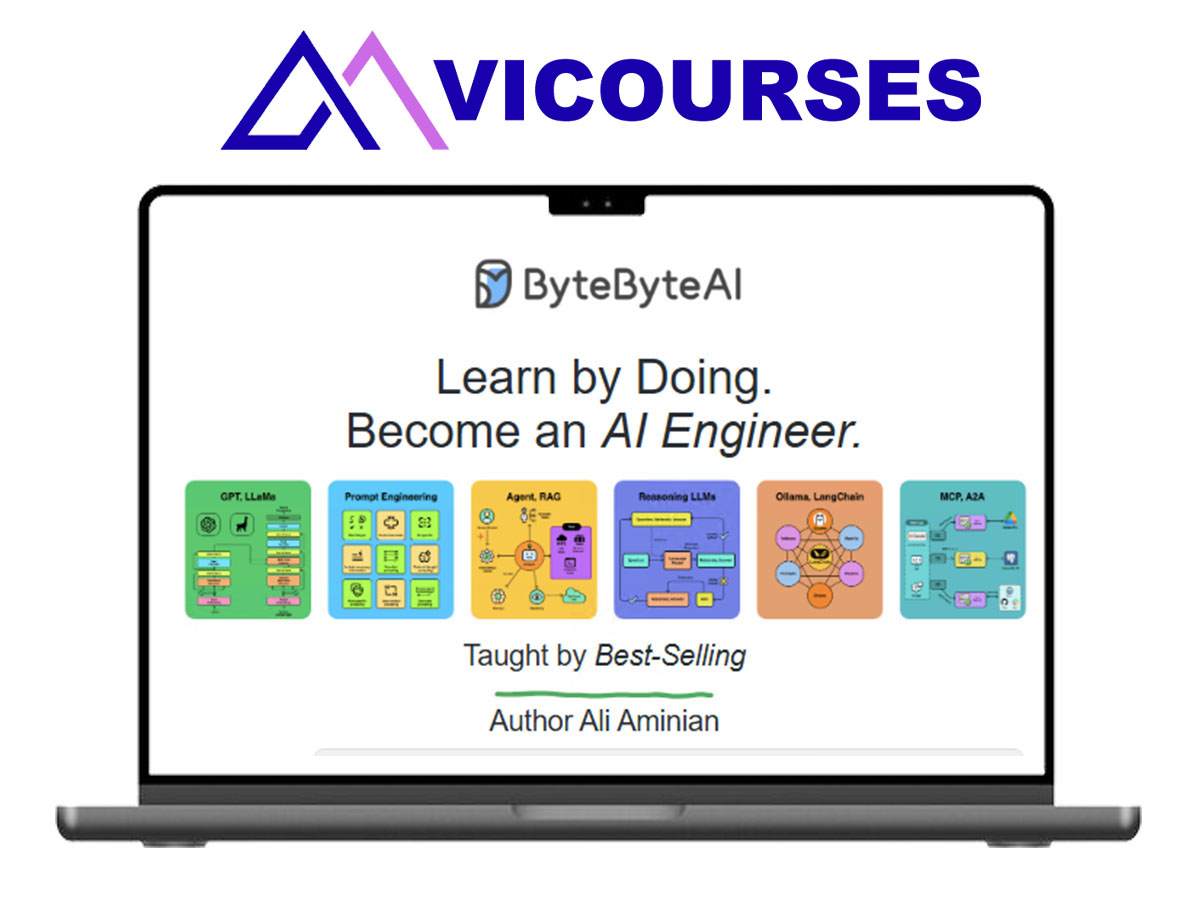
ByteByteAI – Learn by Doing. Become an AI Engineer is a hands-on, project-based AI engineering program designed to help developers, data professionals, and aspiring engineers build practical artificial intelligence systems from the ground up. Rather than concentrating only on theory, the course follows a learn-by-doing approach in which students develop working applications while studying the concepts behind them.
Taught by Ali Aminian, the program covers modern AI engineering topics including large language models, Retrieval-Augmented Generation, AI agents, reasoning workflows, multimodal systems, model evaluation, and deployment. Each section is organized around a practical project, helping students turn technical concepts into portfolio-ready work.
Whether you are transitioning into AI engineering, expanding your software development skills, or looking to understand how modern AI applications are built, ByteByteAI provides a structured path from foundational concepts to more advanced implementation.
What You’ll Learn
Inside ByteByteAI – Learn by Doing, you’ll learn how to:
- Understand the foundations of large language models
- Build AI-powered chatbots using RAG
- Work with embeddings, indexing, and vector search
- Create agents that can call tools and complete multi-step tasks
- Design reasoning and research workflows
- Build multimodal applications using text, image, and video
- Evaluate and improve AI system performance
- Combine several AI components into complete products
- Move an AI project from concept to deployment
- Build portfolio projects that demonstrate practical engineering ability
What’s Included
The program includes:
- Live interactive training sessions
- Step-by-step project-based lessons
- Six major AI engineering projects
- Lifetime access to the course materials
- Peer learning and community support
- Certificate of completion
- Bonus ByteByteGo learning resources
- Practical implementation exercises
- Capstone project development
- Feedback and iteration opportunities
Complete Project Breakdown
Project 1 – Build an LLM Playground
The first project introduces the core ideas behind modern language models and conversational AI systems.
Topics include:
- Large language model architecture
- Tokenization
- Training methods
- Reinforcement learning concepts
- Model evaluation
- Chatbot system design
- Prompt experimentation
- Comparing model behavior
This project helps students understand how LLM-based applications work before moving into more advanced systems.
Project 2 – Customer Support Chatbot With RAG
Build a customer support application using Retrieval-Augmented Generation.
You’ll learn:
- Prompt engineering techniques
- RAG architecture
- Document indexing
- Embedding generation
- Vector search
- Retrieval pipelines
- Context injection
- Response evaluation
- Performance tuning
The project demonstrates how AI applications can use external knowledge rather than relying only on the information stored inside a language model.
Project 3 – Ask-the-Web AI Agent
Develop an AI agent capable of using tools, browsing information sources, and completing multi-step workflows.
Topics include:
- Tool-calling systems
- Agent orchestration
- Multi-step planning
- Workflow design
- Decision-making logic
- Agent memory
- Error handling
- Multi-agent architectures
This section focuses on moving beyond simple chatbot interactions and building systems that can take actions.
Project 4 – Deep Research System
Create an AI research workflow designed to collect, analyze, and organize information across several reasoning steps.
You’ll explore:
- Reasoning model workflows
- Chain-of-thought concepts
- Tree of Thoughts
- Research planning
- Information synthesis
- Iterative refinement
- DeepSeek reasoning models
- OpenAI reasoning model workflows
- Reinforcement learning concepts
The goal is to understand how advanced AI systems break complex tasks into smaller steps and improve answers through structured reasoning.
Project 5 – Multimodal AI Agent
Build an AI application capable of working with more than one type of media.
Topics include:
- Multimodal AI architecture
- Image generation
- Video generation
- Diffusion models
- Generative Adversarial Networks
- Variational Autoencoders
- Transformers
- Text-to-image workflows
- Text-to-video workflows
- FID evaluation
- CLIP Score evaluation
This project introduces the principles behind systems that combine language, images, and video.
Project 6 – Capstone AI Application
Bring everything together by building a complete, portfolio-ready AI product.
You’ll work through:
- Selecting a real-world problem
- Designing the application architecture
- Choosing the appropriate models
- Building the data workflow
- Developing the user experience
- Testing system performance
- Evaluating outputs
- Deploying the project
- Collecting feedback
- Improving the final product
The capstone gives students an opportunity to demonstrate that they can design and implement a full AI application independently.
Why This Course Stands Out
Many AI courses teach isolated tools, code snippets, or theoretical concepts without showing how those pieces fit into a complete system.
ByteByteAI – Learn by Doing takes a more practical approach by organizing the curriculum around real engineering projects.
Key strengths include:
- Project-based learning
- Modern AI engineering topics
- Step-by-step implementation
- Practical system design
- Portfolio-focused outcomes
- Coverage of LLMs, agents, RAG, reasoning, and multimodal AI
- A structured progression from fundamentals to deployment
- Live instruction and community support
Practical AI Engineering Skills
Throughout the program, students develop skills that are relevant to real AI product development.
These include:
- Designing AI application architecture
- Building retrieval systems
- Connecting models to external tools
- Creating multi-step workflows
- Evaluating model output
- Managing prompts and context
- Combining AI services
- Improving reliability
- Debugging AI systems
- Deploying working applications
The emphasis is not simply on understanding what AI technologies are, but on learning how to use them to build complete systems.
Key Benefits
By completing the course, students can:
- Gain hands-on AI engineering experience
- Build several portfolio-ready projects
- Understand how modern AI products are structured
- Improve Python and application development skills
- Learn how RAG systems work
- Develop practical AI agent workflows
- Explore multimodal generation
- Build a complete capstone product
- Strengthen preparation for AI engineering roles
- Move beyond passive tutorials into real implementation
Who This Course Is For
This program is suitable for:
- Developers transitioning into AI engineering
- Software engineers building AI features
- Data scientists exploring LLM applications
- Machine learning practitioners
- Technical founders
- Students building AI portfolios
- Engineers interested in RAG and agents
- Professionals exploring multimodal AI
- Anyone seeking practical AI implementation experience
Some programming familiarity is likely helpful because the course focuses on building working systems rather than only discussing concepts.
About Ali Aminian
Ali Aminian is an AI educator, author, and technical practitioner with experience building and explaining machine learning systems. His teaching approach combines technical foundations with project-based implementation, helping students understand both how modern AI technologies work and how to apply them in real products.
Through ByteByteAI, he guides students through practical engineering workflows involving language models, agents, retrieval systems, reasoning architectures, and multimodal applications.
Frequently Asked Questions
Is ByteByteAI suitable for complete beginners?
The learning path begins with foundational concepts, but basic programming experience will make the technical projects easier to follow. The program is especially relevant for developers, engineers, and data professionals moving into AI.
Does the course cover large language models?
Yes. Students study LLM architecture, tokenization, training concepts, evaluation, chatbot design, and practical application development.
Is Retrieval-Augmented Generation included?
Yes. A full project is dedicated to creating a customer support chatbot using RAG, embeddings, indexing, retrieval, and evaluation.
Does the course teach AI agents?
Yes. Students build an Ask-the-Web agent and learn tool calling, planning, workflow orchestration, and multi-agent concepts.
Is multimodal AI covered?
Yes. The multimodal project introduces image and video generation, diffusion models, transformers, GANs, VAEs, and evaluation metrics.
Will I build a portfolio project?
Yes. The capstone section focuses on building a complete AI application that can be presented as part of a professional portfolio.
Is lifetime access included?
According to the provided course details, lifetime access to the training materials is included.
Final Thoughts
ByteByteAI – Learn by Doing. Become an AI Engineer offers a structured, implementation-focused path for anyone who wants to build practical AI systems rather than just study theory. Through projects involving LLMs, RAG chatbots, AI agents, deep research workflows, multimodal applications, and a complete capstone product, the program helps students understand how modern AI applications are designed and developed.
Its project-based structure makes the course particularly useful for developers and technical professionals who want to strengthen their skills, create portfolio-ready work, and gain experience with the technologies shaping modern AI engineering.